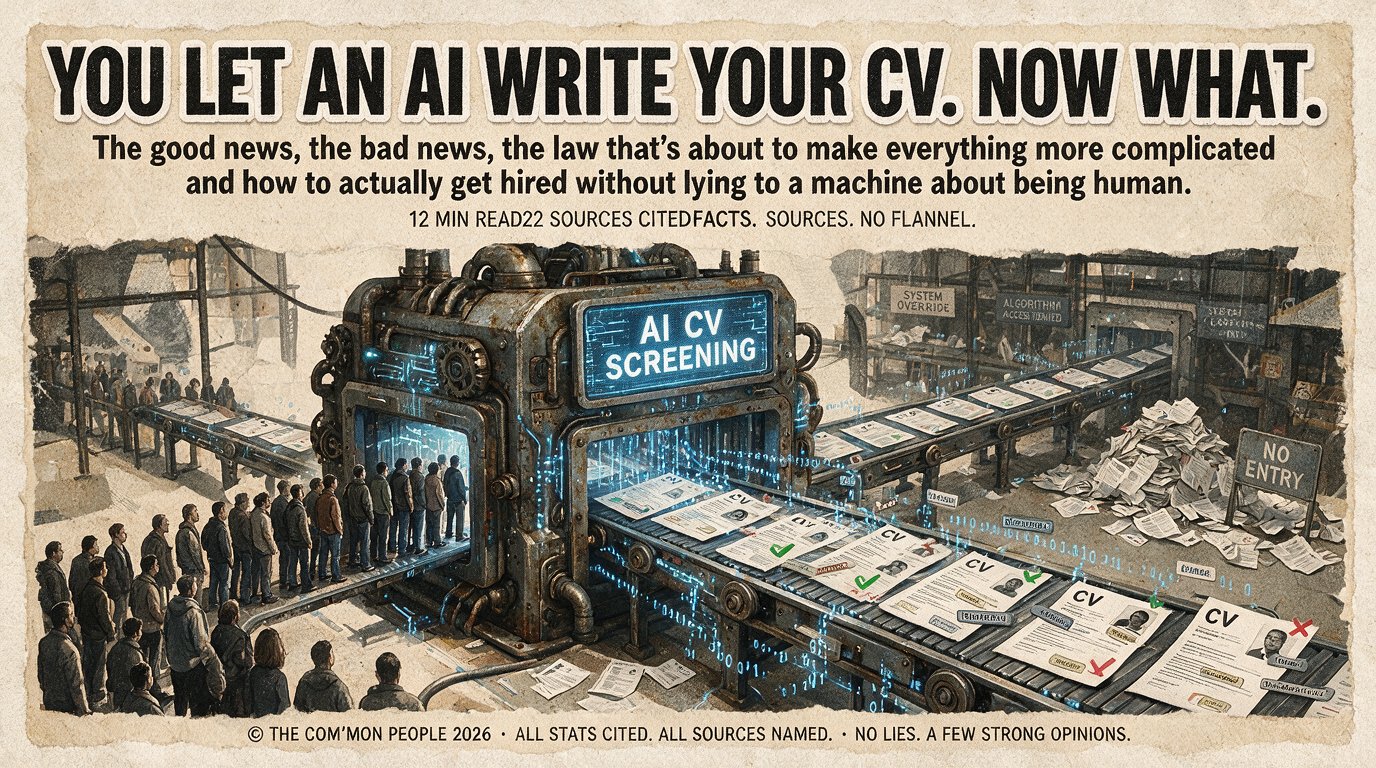
The CV gets read in 11 seconds. The machine decides in 3.
Everyone’s doing it.
Everyone thinks they can spot it.
Neither of those things are entirely true. But both of them affect you.
The hypocrisy is real.
So is the reason.
Employers using AI to screen CVs while hating that candidates use AI to write them isn’t contradiction. It’s a signal problem. Here’s what they’re actually worried about.
The signal is dead. A CV exists to answer one question: can this person do this job? AI produces text that reads like someone who can do every job. It’s not lying, exactly. But it’s noise where there should be signal.
They can’t assess you. 78% of hiring managers say personalised details signal genuine interest and fit. An AI CV is a personalised impression of a generic candidate. The bit they’re looking for you isn’t there. Source: Resume Now, 2025.
Volume tsunami. 64% of recruiters already saw more look-alike applications in 2024–25 thanks to GenAI. ResumeBuilder/ZipRecruiter, 2025. The same recruiter who used to get 100 CVs now gets 500. All of them start with “results-driven professional.”
“Results-driven professional with a proven track record of leveraging cross-functional synergies to deliver transformational outcomes in fast-paced, dynamic environments.”
“Grew ARR from £1.2m to £4.8m in 18 months by cutting our sales cycle from 47 to 19 days. Here’s exactly how.”
First example: AI-generated. Second example: human-written, specific, verifiable. One of these gets callbacks.
The extra kicker
A National Bureau of Economic Research randomised controlled trial of 480,948 job seekers found AI writing assistance increased hiring by 7.8%. The key word is assistance AI used to sharpen human-written content, not replace it. NBER Working Paper 30886, 2023. Still the best-controlled study on the topic.
They clocked it in 20 seconds.
33.5% of hiring managers say they can spot an AI-generated CV in under 20 seconds. Not because they have superpowers. Because AI makes the same mistakes, every time. TopResume survey of 600 hiring managers, May 2025.
The “results-driven” opener.
ChatGPT loves this phrase. So does Claude. So does Gemini. If your CV starts here, every recruiter’s stomach sinks a little.
Impeccable grammar, zero personality.
AI produces text that’s grammatically perfect but lacks a human voice. No anecdotes. No texture. No sense of a person behind the words.
Nice words, no numbers.
“Led successful projects” what projects? What counts as success? AI creates text that sounds nice but says nothing. A real candidate says: “Delivered 12-market rollout, £2.4m under budget, Q2 2025.”
Wrong skill level.
AI inaccurately attributes skill levels. “Expert in crisis management” for someone two years into their career. Recruiters know how skills develop. The mismatch is a glaring flag.
Inconsistent tone.
Formal in one paragraph (“optimised operational workflows”), casual in the next (“really excited to contribute”). Different AI prompts, different results. One CV, multiple voices. Human CVs don’t do this.
Zero company or role context.
The cover letter doesn’t mention the company name. Or the role. Or the hiring manager. Because you made one prompt and sent it 40 times. They know. 53% of hiring managers are frustrated by impersonal outreach. Resume Now, 2025.
It’s suspiciously perfect.
Humans make choices. They emphasise some things and underplay others. AI tries to include everything because it doesn’t know what matters. A CV that covers every possible skill is a CV written by something with no skin in the game.
They interview you. You wrote “expert in Salesforce architecture.” They ask you one detailed question. You pause for three seconds. That’s the tell. The CV lied. You didn’t mean to. But here you are.
The EU AI Act. Coming for HR.
Right now.
The world’s first comprehensive AI law entered into force August 2024. For recruitment specifically, the critical deadline is August 2, 2026. As in: this month. European Commission, Regulation (EU) 2024/1689.
Act enters into force. The regulation is law. The clocks started.
Prohibited AI practices banned. Emotion recognition in hiring: illegal. Biometric categorisation by protected characteristics: illegal. If you were using these, you’ve already broken the law. Source: Article 5, EU AI Act.
Full enforcement. High-risk rules live. CV screeners, candidate ranking, interview AI, performance prediction all classified as high-risk. Mandatory: bias testing, human oversight, audit trails, transparency with candidates. Sources: Articles 9–15, EU AI Act; Annex III, Section 4.
Fines start landing. Up to €35 million or 7% of global annual turnover. Whichever is higher. Source: rexx-systems.com citing EU AI Act penalty framework.
Tell candidates when AI is being used to assess them.
Run bias audits on every AI hiring tool.
Keep audit trails documenting decisions made.
Ensure a human can override any AI decision.
Train staff on AI literacy mandatory from Feb 2025.
Register high-risk systems in the EU database.
Source: Articles 9–15, EU AI Act (Regulation EU 2024/1689). Hiretruffle.com compliance guide, April 2026. Boundlesshq.com, March 2026.
This applies to any company using AI to hire people in the EU, even if the company is based in the US, UK, or anywhere else. You hire one person in Germany using an AI CV screener? Welcome to compliance obligations.
Source: Hiretruffle.com EU AI Act guide, April 2026 confirmed by European Commission guidance.
The EU AI Act doesn’t apply in the UK post-Brexit. The UK is pursuing a “pro-innovation” framework without a single binding AI law yet. Regulators are developing sector-specific guidance. Watch this space. Source: Boundlesshq.com, March 2026.
The job search has always been hard. Now it is just differently hard.
How to beat the bots
without being one.
ATS software is used by 97.8% of Fortune 500 companies. Jobscan ATS Usage Report, July 2025. Skills-first hiring is now the standard, with 43% of businesses making it their top priority. The Interview Guys, May 2026. Here’s what actually works.
That “75% auto-rejection” stat is made up. The viral claim that “75% of CVs are auto-rejected before a human sees them” traces back to a sales pitch from a startup that went out of business in 2013. There is no primary source. It was invented to sell resume services. The actual risk is real but different: badly formatted CVs parse wrong. JobCannon.io, 2026, citing research trail.
Parsing failure, not rejection rates. Complex designs, tables, headers and footers, two-column layouts and decorative icons all cause ATS parsers to misread or lose your content. You’re not being rejected. You’re just invisible. Use clean, single-column layouts for any application portal. Keep two versions one ATS-safe, one beautiful for direct email.
Credentials matter less. Proof matters more. With 43% of employers now leading with skills over credentials, your degree from 2009 is doing less heavy lifting than it used to. What does the work: certified skills, measurable outcomes, specific tools and technologies you’ve actually used, portfolio links that work. Source: The Interview Guys, citing ApplyGlide and LinkedIn data, 2026.
Using AI well vs. using AI badly
Use AI to check your CV for typos and inconsistent formatting.
Ask AI to suggest stronger action verbs for your bullet points.
Use AI to identify keywords in a job description you should reflect.
Ask AI to spot where you’ve been vague and need specifics.
Use AI to tailor your existing content to a specific role.
Asking AI to write your entire CV from a job title and three words.
Submitting AI output without reading it out loud to yourself first.
Using AI to claim skills or experience you don’t actually have.
One prompt, 50 identical applications. You will be caught, then rejected.
Trusting AI to know which of your experiences actually matters for this role.
The CV is not dead.
But it needs a trim.
The format has evolved. Skills-first, ATS-compatible, metrics-forward, human-proof. Here is what works in 2026 for machines and for people. Sources: Schulmeister Consulting, March 2026. PE Global, Dec 2025. The Interview Guys, May 2026.
Structure. What every CV needs in 2026.
Professional summary (3 sentences max). Who you are, what you do best, what you’re looking for. No “results-driven.” Specific, personal, yours.
Key skills section, role-specific. List actual tools, technologies, methodologies. Mirror the job ad’s language. Not “Microsoft Office” that’s embarrassing now.
Work history, reverse chronological. Each role: company, title, dates, 3–5 bullet points with metrics. Start every bullet with a verb.
Education (brief). Degree, institution, year. Unless you’re a new grad or it’s directly relevant, it shouldn’t dominate the page.
Links that work. LinkedIn, portfolio, GitHub, anything that proves you exist and have done things. Recruiters now expect these. Source: PE Global, 2026.
“In 2026, AI literacy has become a baseline expectation. Include specific AI tools you use and how you leverage them for efficiency.” The Interview Guys, May 2026. Don’t list “ChatGPT.” List what you used it for and what it produced.
Two pages. One is fine if you’re junior. Three is almost never justified. Not because of an arbitrary rule. Because attention is scarce and your job is to make it easy to say yes to you.
Format. Two versions. Always.
| Aspect | Guidance |
|---|---|
| ATS version | Clean. Single column. Standard headings. PDF. |
| Human version | Designed. Clear hierarchy. Visual hierarchy. For direct sends. |
| Colours | Subtle accents only. ATS parsers don’t care. Humans do. |
| Icons | Contact info only. Never in skills or experience. |
| Font | Minimum 10.5pt. Readable sans-serif. Always. |
“Seeking an exciting opportunity to leverage my skills in a challenging role where I can contribute to a dynamic team.” This is what AI writes. This is also what 80% of people write. Don’t. Tell them what you specifically want and why this role fits. If you can’t write it without sounding like an AI, that’s your cue to think harder about why you actually want this job.
Do CVs need
a complete overhaul?
Only about 37% of employers now see traditional credentials as reliable talent signals. Over 40% are actively ditching resume-first hiring. Willo Hiring Trends 2026. The reckoning is coming. But it’s not here yet.
In some sectors, yes. Tech, creative, engineering portfolio-first hiring is already standard in many organisations. Some companies have replaced CVs with skills tests entirely. If you’re applying to a startup and you haven’t shipped anything, a CV won’t save you.
In most sectors, still. Finance, law, healthcare, professional services, the public sector the CV is alive and the interview process is still largely sequential. The shift is slower here. A bad CV will still cost you. But “bad” now means generic and unverifiable, not two columns.
Evolve, don’t abandon. The CV needs to become a proof document, not a biography. Your job history is context. Your results are the product. Add a portfolio link, a GitHub, a case study, anything that shows rather than tells. The CV plus something beats a CV alone.
The CV gets you to
the phone call. Then what.
Recruiters search it first. 93% of recruiters plan to increase AI use in 2026. LinkedIn is often the first search, not the job board. If your profile contradicts or undersells your CV, that’s a problem before they’ve even read the document. Source: LinkedIn Talent Solutions, January 2026.
Optional but not pointless. 80% of employers are uneasy seeing AI-generated cover letters. They’re optional more often now. When you do write one: three paragraphs. Why this role. Why now. What specific thing you bring that the job description is clearly looking for. CrownStaffing, January 2026.
They’re coming for you. AI-conducted interviews tripled in two years from 10% to 34%. Two-thirds of recruiters plan to expand AI pre-screening in 2026. Your CV is now just the warm-up. CoverSentry, 2026, citing ResumeBuilder data.
You’re allowed to ask questions too. 66% of Americans say they wouldn’t apply to an employer that uses AI for final hiring decisions. Pew Research, cited in SQ Magazine, 2026. You’re allowed to ask how decisions are made. Under the EU AI Act, in Europe, they’re legally required to tell you.
The ten things.
Do them. Done.
No waffle. No hedging. The ten things that actually change outcomes.
Sources & references
Every stat cited. Every claim sourced.
- Resume Now. AI and the Applicant Report. March 2025. n=925 HR professionals.
- Insight Global. AI in Hiring Survey. 2025.
- CoverSentry. AI in Hiring Statistics 2026 (20+ survey compilation). March 2026.
- Jobscan. ATS Usage Report. July 2025.
- LinkedIn Talent Solutions. Future of Recruiting. January 2026.
- ResumeBuilder. Business Leaders Survey. n=948. Oct 2024.
- SHRM. State of HR / AI Adoption. 2025 and 2026 surveys.
- European Commission. Regulation (EU) 2024/1689 AI Act. August 2024.
- Hiretruffle.com. EU AI Act and Hiring. April 2026.
- Boundlesshq.com. EU AI Act Employer Guide. March 2026.
- HeyMilo. EU AI Act Changes Recruitment. Updated April 2026.
- Omniteam.ai. EU AI Act and Recruitment. February 2026.
- NBER. Working Paper 30886. 2023. n=480,948 job seekers.
- Pew Research. AI in Hiring Attitudes. 2025. Cited: SQ Magazine, May 2026.
- Willo. Hiring Trends 2026. n=100+ HR professionals.
- The Interview Guys. Resume Formats for 2026. May 2026.
- TopResume. Hiring Manager Survey. n=600. May 2025.
- PE Global. What Your CV Should Look Like in 2026. December 2025.
- JobCannon.io. AI Resume Statistics 2026 (72 verified stats). May 2026.
- World Economic Forum. Future of Jobs 2025. Cited: recruitment.com, March 2026.
- Scale.jobs. 7 Signs Recruiters Know Your Resume Was AI-Written. April 2026.
- CrownStaffing. Cover Letters in the AI Era. January 2026.