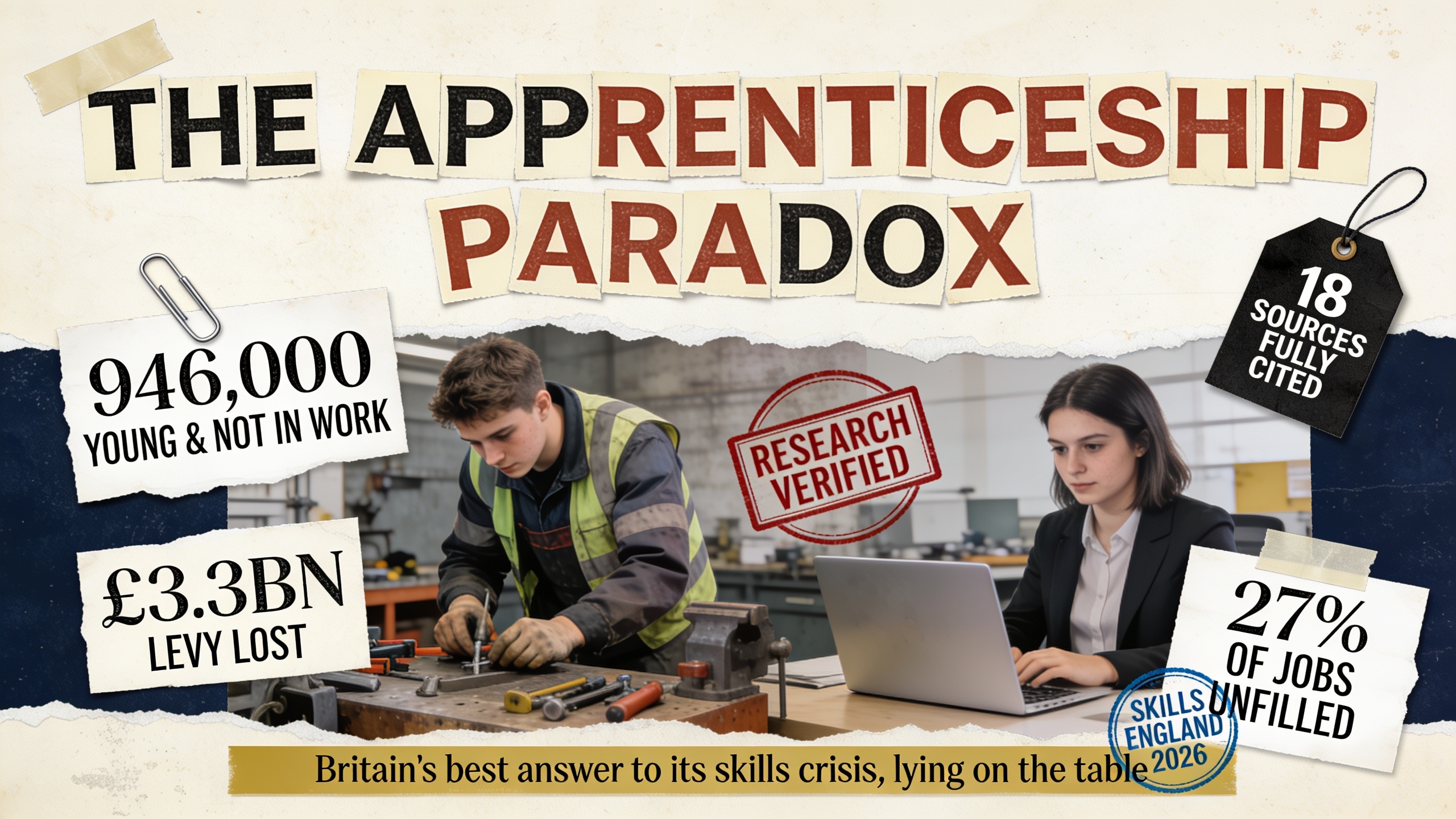
Two problems, one obvious bridge between them, and yet year after year we struggle to build it.
There are, on the most recent official count, roughly 946,000 young people in the UK aged 16 to 24 who are not in education, employment or training. In England alone, that is more than one in eight of the age group. At the same time, more than a quarter of all job vacancies in the country now go unfilled because employers cannot find the skills they need. Two problems, one obvious bridge between them. This is the story of why we keep failing to build it, and of what apprenticeships could be if we let them.
We keep forgetting
what actually works.
Apprenticeships are not a modern invention dreamed up by a skills unit. They run in an unbroken line from the medieval craft guilds through the Elizabethan Statute of Artificers of 1563, which for centuries made a seven-year apprenticeship the legal gateway into a trade. For most of our history, learning a job by doing it, under the eye of someone who had already mastered it, was simply how work was passed on.
The Statute of Artificers makes a seven-year apprenticeship the legal route into a trade. Learning by doing is the norm for centuries.
Manufacturing contracts, industrial apprenticeships collapse, youth unemployment surges. The Youth Training Scheme is pitched as the fix and widely seen as cheap labour and a holding pen. Governments avoid the word “apprenticeship” entirely, thinking it old-fashioned.
Modern Apprenticeships restore the crucial principle: an apprentice is an employee earning a wage, not a trainee parked on a scheme.
Verdict: the “frameworks” had become cumbersome and confusing. Its fix built the system we have now, replacing frameworks with employer-designed standards around real job roles.
The Apprenticeship Levy arrives to fund the system.
The Institute for Apprenticeships and Technical Education is closed and its functions absorbed into a new body, Skills England.
The picture is better than
the mood suggests.
In the 2024/25 academic year there were 353,500 apprenticeship starts in England, up 4.1% on the previous year. Some 761,500 people were participating at some point in the year, and 198,300 completed and achieved. After years in which achievement was a genuine embarrassment, the rate rose to its best result to date.
The shape of who does apprenticeships has changed dramatically, and it matters for everything that follows. Women were 52.5% of starts. The single largest area was Business, Administration and Law. And higher apprenticeships at Level 4 and above rose 15.1% to 140,730, now close to 40% of all starts, with degree-level programmes growing strongly.
The public image of an apprenticeship, a teenager in overalls, is now badly out of date. There are more than 500 standards, spanning Levels 2 to 7. You can apprentice as a nuclear scientist, a solicitor, a data analyst, a chartered surveyor, a nurse, an accountant or a chief executive’s right hand. The range is one of the system’s best-kept secrets.
The biggest lever,
and the biggest frustration.
Introduced in 2017, the Levy requires every employer with a pay bill above £3 million to pay 0.5% of it into a digital account, to be spent on apprenticeship training. The intention was sound: force large employers to invest, and stop the free-riding whereby some firms poach talent that others paid to train. The execution has been the problem.
This is why the system is being rebuilt again. The Levy is being reshaped into a broader Growth and Skills Levy, overseen by Skills England, to give employers more flexibility than full apprenticeships alone. The direction confirmed at the Autumn Budget is significant, and every employer should understand it.
Full funding for the young in small firms. Apprenticeships for eligible under-25s at non-levy-paying employers, mainly SMEs, become fully government-funded. For a small firm that hesitated over cost, that is close to removing the price tag.
A shorter runway. From 2026/27 the expiry window on levy funds tightens from 24 months to 12. Money must be committed faster or lost faster.
Less generous top-ups. The 10% government top-up is removed, and once a levy-payer exhausts its own funds it pays 25% of further training costs, up from 5%.
Level 7 defunding. From January 2026, public funding for master’s-level apprenticeships is withdrawn for anyone aged 22 and over, kept only for 16 to 21-year-olds and a few exceptions such as care leavers.
Foundation Apprenticeships. A new tier for 16 to 21-year-olds, starting with seven courses in construction, digital, health and social care, and engineering, an explicit attempt to rebuild the entry-level pipeline the levy years hollowed out.
Read together, the reforms send one message: the money is being pushed decisively towards young people and towards the firms most likely to hire them. For SMEs, apprenticeships are about to get cheaper. For large employers used to spending levy on their own management training, the room to do so is narrowing.
The barriers are real.
Most are surmountable.
If the case is so strong, why do so many employers hold back? The honest answer is that the barriers are real, but most can be overcome, and several are more perception than substance.
In survey after survey, employers describe a maze. 43% of SMEs say the system is simply too complicated, and around a quarter say it is too bureaucratic. The fix is partly national, but also practical: a good provider or a levy-transfer scheme can absorb most of the admin. The complexity is real, but it can be outsourced.
Around 26% of employers say they don’t believe there is an apprenticeship relevant to them, and 14% feel too small. With over 500 standards live, the first belief is usually mistaken. The answer is not leaflets, it is a conversation with a provider who can map real roles to real standards.
22% worry apprentices will leave the moment they qualify. The evidence points the other way: apprentices are, if anything, more loyal, because they have been invested in and integrated into the culture.
Supervision and mentoring time, a productivity dip while someone learns, and releasing apprentices for off-the-job training (at least 20% of their time). Genuine, but front-loaded, and for smaller firms taking on the young, the funding reforms are about to remove the largest of them.
An employer who treats training as a reason not to develop people has the logic backwards. As the old line goes, the only thing worse than training your people and losing them is not training them and keeping them.
The commercial case
stands on its own.
It would be a mistake to sell apprenticeships purely as a good deed. Britain has a skills shortage getting worse, not better, and instead of responding by training more, business has been training less.
Independent and provider analyses vary and should be read critically, since they are often produced by training companies. But they point one way, with commonly cited figures suggesting a return of well over £20 for every £1 invested in Level 2 and 3 programmes, and around seven in ten employers reporting that apprenticeships improve retention. Treat the multiples as indicative, not gospel.
A tool for the people
you already have.
Here is the most misunderstood fact about the modern system: an apprenticeship is not only for new recruits, and not only for the young. In 2024/25, 51.3% of starts were people aged 25 and over. The majority were existing workers being upskilled. Any employee, at any age, can do one, provided it teaches substantially new skills.
Team Leader / Supervisor
Carries a CMI Level 3 qualification. Built for the exact moment a strong operator is promoted to manage their former peers, the transition most organisations handle worst.
Operations / Departmental Manager
With a CMI Level 5 qualification. Develops middle managers, and higher standards run all the way up to senior leadership, often funded through the levy.
The loyal employee who has been with you fifteen years, knows the business inside out, but has never held a formal qualification, can gain one that recognises what they already do and stretches them into what comes next, without the disruption of an external hire. There are documented cases of workers starting apprenticeships in their late fifties. Used this way, an apprenticeship tells your existing people the business will invest in them, not just recruit over their heads.
Match the programme
to the person.
One reason apprenticeships fail, and one reason employers get burned and give up, is poor matching. Success is not simply finding a young person who says they want to do it. It is pairing the right person with the right programme, and being honest about what each requires. An apprenticeship combines a real job, real study and formal assessment, usually over one to four years.
A practical, hands-on school leaver bored rigid by exams may be transformed by a Level 2 or 3 apprenticeship, and lost entirely by being pushed towards A-levels they do not want.
Others need the scaffolding of a classroom before they are ready for the workplace. Forcing a Level 2 candidate onto a Level 4 means they drown. Get the level right.
Good matching means assessing aptitude and temperament, not just enthusiasm, being clear about the level, and involving the line manager who will mentor them from the start. Treat selection with the rigour of any other hire, and think about who in the existing team is ready to be developed, not only who you can bring in. Matching is where the social good and the business return meet.
Leadership in your
own backyard.
Return to the number this piece opened with. Roughly 946,000 young people across the UK are not in education, employment or training, about 13.3% in England, more than one in eight. The rate was 10.3% just four years ago, and around half of the older group are “hidden”, claiming no benefits and invisible to the system. Behind every percentage point are real young people in real towns, and the cost of a generation left idle lands on all of us.
A serious choice,
not a fallback.
For decades the message from schools, and often parents, was implicit but relentless: university is success, everything else is what you do if you cannot manage it. That message is out of date, and in many cases financially wrong.
At 16. For a school leaver who has had enough of the classroom, an apprenticeship offers what further education often cannot: a real job, a wage from day one, and a nationally recognised qualification, all at once. The apprentice minimum wage rises to £8.00 an hour from April 2026, and many employers pay well above it. Crucially it is not a dead end. The ladder now runs from Level 2 to a Level 7 master’s-equivalent, so a young person can begin at sixteen with no qualifications and, in time, reach the same destination as any graduate, by a different road.
At 18. A degree apprenticeship is a serious, and often superior, alternative to university. Consider the economics.
| University route | Degree apprenticeship | |
|---|---|---|
| Tuition | Around £45,000 of debt on graduation. | Nothing. Fees covered by the employer and the levy. |
| Income | Earning starts after graduation. | A salary throughout, commonly around £24,000 and rising. |
| Outcome | A Level 6 degree. | The same Level 6 degree, plus years of real experience and often a permanent job. |
Estimates that degree apprentices can be six figures better off by their early twenties should be read as illustrative. The direction is not in doubt: no debt, plus a salary, plus a degree, is a powerful combination.
Degree apprenticeships are fiercely competitive, often harder to win than a university place, and the range of subjects is narrower. Over a full career a good Level 5 apprenticeship can out-earn a degree from a non-selective university, while a degree from a highly selective, Russell Group or Oxbridge university still tends to produce the highest lifetime earnings of all, approaching £2 million. University remains the right choice for many. But the lazy hierarchy, university good and apprenticeship second-best, does not survive contact with the numbers.
Britain’s best answer
is lying on the table.
Sources & references
Every figure was checked against the sources below. Where numbers come from advocacy groups or commercial training providers rather than official statistics, notably some ROI and salary-comparison figures, that is flagged in the text and the estimates should be read as indicative.
- Apprenticeships, Academic year 2024/25. DfE / Explore Education Statistics.
- Apprenticeship achievement rate 2024/25 (65.4%). FE Week.
- Budget 2025, Growth and Skills Levy (official reform detail). DfE Apprenticeship Service.
- Skills policy in England (Growth & Skills Levy, Skills England). House of Commons Library.
- Level 7 apprenticeship funding axed from January 2026. FE Week.
- £3.3bn unspent levy returned to the Treasury. IPPR.
- A short history of apprenticeships in England. House of Commons Library.
- Youth Training Scheme, background.
- Richard Review of Apprenticeships (2012). GOV.UK.
- Admin barriers holding SMEs back from hiring apprentices. Startups.co.uk.
- Employer barriers (relevance, size, retention). The 5% Club / Employer Skills Survey.
- Employer Skills Survey 2024 (skills-shortage vacancies, training spend). GOV.UK.
- Apprenticeship ROI and business benefit figures (provider / NAS analyses, indicative).
- Upskilling existing staff; Team Leader / Operations Manager standards and CMI.
- NEET statistics, UK (946,000; 13.3% England). ONS, November 2025.
- Apprenticeships, social mobility and disadvantage. The Sutton Trust.
- Apprentice minimum wage rising to £8.00 (April 2026).
- Apprenticeship vs university, earnings, debt and lifetime comparison (provider analyses, indicative).